
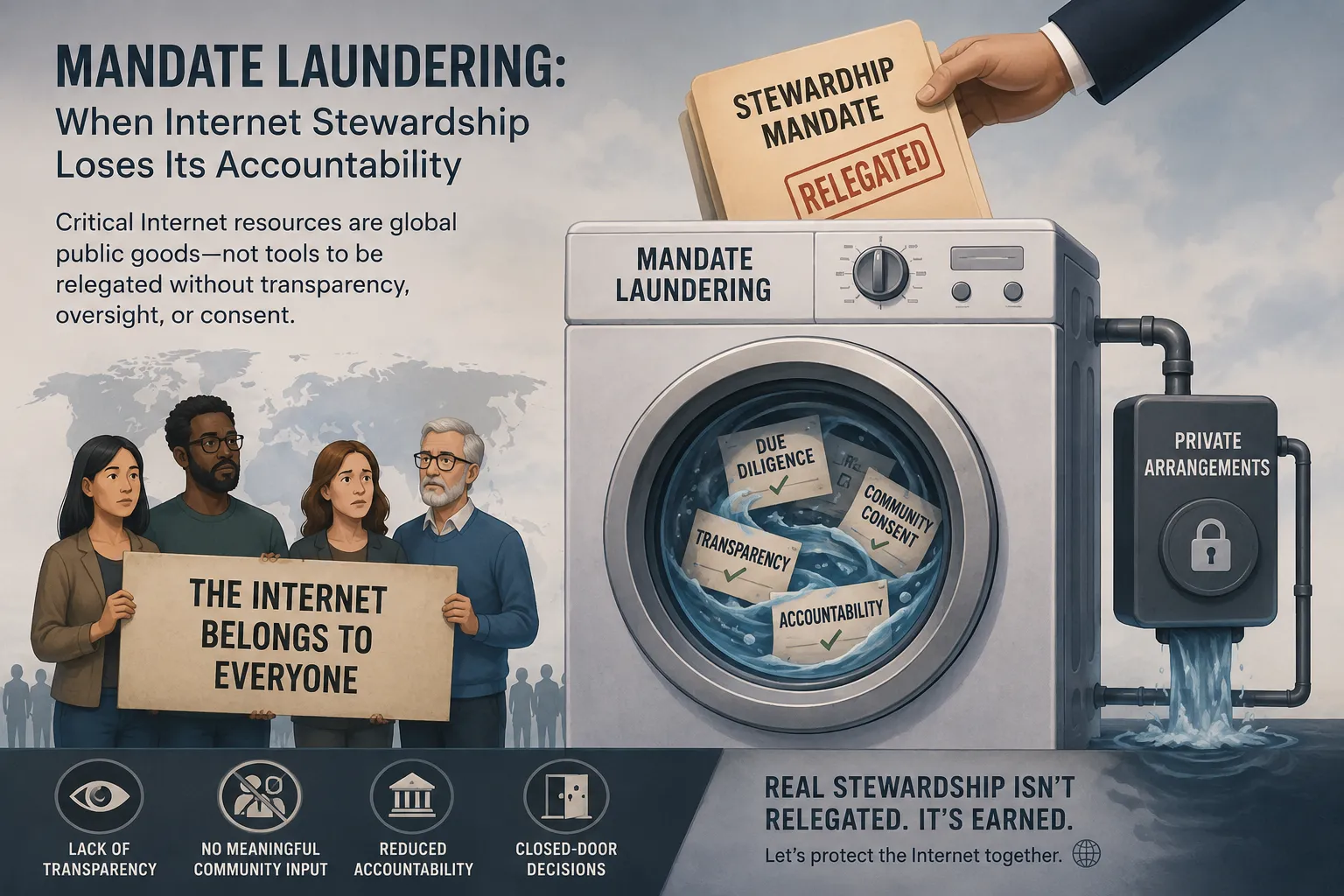
Internet number resource governance depends on trust.
Networks need unique addresses.
Operators need reliable records.
Transfers need predictable processes.
Routing needs confidence.
Businesses need continuity.
A coordination layer can support all of this when its role is narrow, clear, and accountable.
But a coordination role can become dangerous when it is gradually described as something larger than it was designed to be.
This is the concern behind Mandate Laundering: a limited technical or administrative function may be presented as if it carries broader authority over operators, regions, markets, or public interest, even when that wider authority has not been clearly granted.
For Internet number resources, this matters because IPv4 addresses are no longer low-value technical records. They support live networks, customer access, digital services, infrastructure investment, and business continuity.
Responsible stewardship must therefore separate useful coordination from excessive mandate expansion.
The issue is not whether coordination should exist. It should. The issue is whether coordination remains proportionate to its purpose.
What Is Mandate Laundering?
Mandate laundering happens when a narrow role is gradually presented as if it carries broader authority than originally justified.
In Internet governance, this can happen when a technical coordination function is described using language that sounds like political representation, public ownership, regional authority, or broad community mandate.
The concern is not that coordination bodies should stop coordinating. The concern is that coordination may be rhetorically expanded into control.
A registry or resource coordination body may maintain records, support uniqueness, process updates, and help preserve operational stability. Those are important functions.
But maintaining records is not the same as owning the economic reality created by the operators who build, finance, and run networks.
That distinction is central to responsible Internet stewardship.
For the wider doctrine behind this issue, see Mandate Laundering frames the issue as the transformation of narrow coordination into a thicker claim of authority through procedural and regional language.
Why Mandate Clarity Matters
Mandate clarity matters because infrastructure systems depend on predictable roles.
Operators need to know who records resources, who validates transfers, who maintains contact information, who handles disputes, and who bears responsibility when decisions affect continuity.
When mandates are clear, operators can plan around them.
When mandates expand through rhetoric rather than transparent authority, uncertainty increases.
That uncertainty can affect:
- IPv4 transfer planning
- resource portability
- business continuity
- legal and compliance review
- routing confidence
- operator trust
- investment decisions
For smaller networks, the cost of that uncertainty can be especially high because they may not have the capital or legal capacity to absorb long procedural disputes.
Coordination Is Not Ownership
Internet number resources require coordination because uniqueness matters. If two unrelated networks claim the same address space at the same time, the result can create operational conflict.
Coordination helps prevent that.
But coordination is not ownership.
A record system can help make resource use legible. It can support transfers, contact accuracy, and operational trust. Yet the value around IPv4 is created by operators who deploy capital, build networks, serve customers, and carry the downside of disruption.
This is why Internet number resources should not be treated as political property or institutional trophies.
A responsible governance model should recognize the difference between:
- record-keeping and ownership
- coordination and control
- stewardship and overreach
- public-interest language and actual accountability
- community participation and universal representation
When Stewardship Language Becomes Risky
Stewardship can be a useful word when it means careful management of a shared technical system.
But stewardship language becomes risky when it is used to justify discretionary control without matching responsibility.
If an institution claims a broad stewardship role over resources that support real businesses, then the scope of its accountability should also be clear.
Operators should be able to ask:
- What is the exact authority being exercised?
- Where does that authority come from?
- What limits apply to it?
- What remedy exists if the authority is exercised incorrectly?
- Who carries the business consequence if a decision disrupts continuity?
These questions are not anti-governance.
They are the foundation of credible governance.
Without clear limits, stewardship can become a vague justification for power. That weakens trust rather than strengthening it.
Why Operators Need Predictable Resource Governance
Network operators need predictability because their services depend on continuity.
IPv4 resources may support:
- hosting platforms
- cloud infrastructure
- telecom systems
- VPN services
- security platforms
- email delivery
- enterprise access controls
- customer-facing applications
When resource governance becomes unclear, the risk does not remain theoretical.
It may appear as delayed transfers, uncertain renewals, documentation disputes, routing concerns, reputational pressure, or reduced confidence in the long-term usability of address space.
A stable system should make it easier for operators to understand their rights, responsibilities, and operational pathway.
It should not make operators guess whether a coordination function may later become a broader authority claim.
The Compliance Problem with Unclear Authority
Compliance teams need clear rules.
When an organization uses IPv4 resources in production, legal and compliance teams may need to review contracts, registry records, transfer documents, routing authorizations, customer obligations, and operational risk.
Mandate uncertainty makes that review harder.
If a role is described narrowly in one context and broadly in another, businesses may struggle to understand what exposure they are accepting.
This can affect:
- risk assessment
- procurement approval
- audit readiness
- contract negotiation
- investment planning
- business continuity planning
A legally careful governance environment should avoid exaggerated claims and maintain precise language.
It should say what it does, explain why it does it, and remain clear about what it does not control.
What Responsible Mandate Design Should Prioritize
Responsible mandate design should support Internet stability without inflating coordination into unnecessary control.
A healthy resource-governance framework should prioritize:
Clarity: roles, powers, limits, and procedures should be easy to understand.
Proportionality: process should not exceed the coordination problem it is meant to solve.
Accountability: influence over high-consequence resources should be matched by meaningful responsibility.
Continuity: governance should protect live networks and customer-facing services.
Portability: lawful movement of resources should be predictable and transparent.
Neutrality: coordination should not become political ownership language.
Operational realism: rules should reflect how networks actually deploy, route, and depend on IPv4 resources.
These principles do not remove the need for coordination.
They make coordination more credible.
How Larus.Foundation Frames the Issue
Larus.Foundation frames mandate clarity as part of responsible Internet resource stewardship.
The goal is not to reject governance. The goal is to ensure governance remains technically useful, legally careful, and operationally fair.
A coordination layer should help preserve uniqueness, accuracy, portability, and continuity.
It should not create uncertainty by expanding its mandate through vague language, symbolic authority, or assumptions that affected operators did not clearly grant.
This matters because IPv4 resources are embedded in real infrastructure. They are connected to customers, contracts, routing, services, and business continuity.
For Larus.Foundation, responsible stewardship means asking whether the system:
- keeps records accurate
- keeps rules understandable
- keeps authority limited
- keeps operators protected from unnecessary uncertainty
- keeps the Internet’s uniqueness layer stable and trusted
A system that meets these tests can earn trust. A system that does not may need reform, clarification, or stronger accountability.
Final Thought
Mandate laundering is dangerous because it can happen quietly.
A narrow role becomes a broader claim.
A coordination task becomes a control narrative.
A service geography becomes a political identity.
A record-keeping function becomes a theory of authority.
Each step may sound harmless on its own.
But together, they can make Internet number resource governance less predictable and less accountable.
Responsible stewardship requires the opposite: clear roles, limited authority, transparent process, and respect for the operators who build and maintain the networks that make the Internet real.
The future of Internet number resource governance should not depend on vague claims of authority.
It should depend on clarity, continuity, accountability, and operational truth.