For most ISPs and tech companies, the monthly or annual fees paid to Regional Internet Registries (RIRs) are viewed as a "necessary evil"—a boring administrative expense required to keep the lights on.
But there is a dangerous reality hiding behind those invoices. If you are simply paying fees without a seat at the policy table, you aren't an owner. You are a Digital Tenant. And in 2026, the rent is getting higher, the rules are changing, and the threat of "digital eviction" is real.
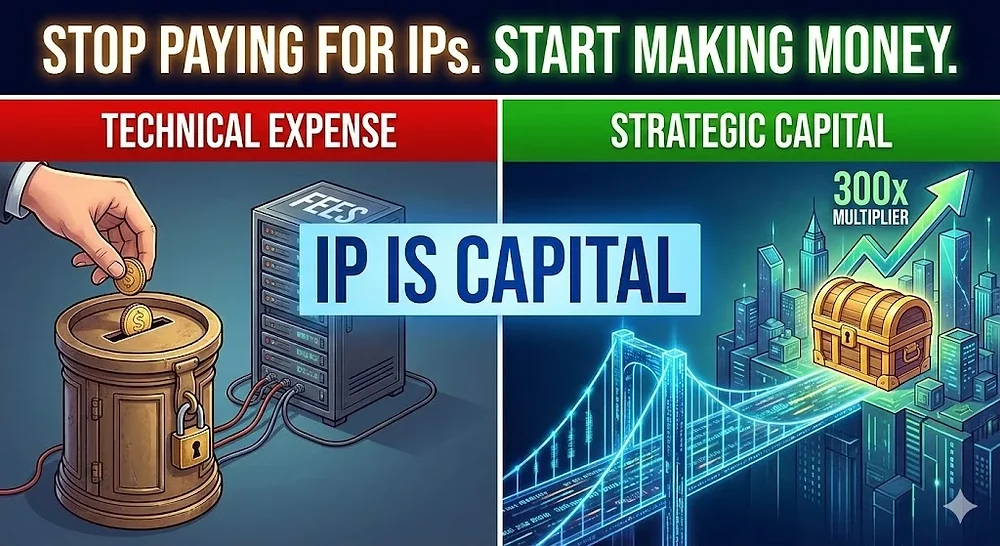
The IPv4 Asset Paradox: Why IP is Capital, Not a Technical Expense

Imagine owning a high-rise in the heart of Kuala Lumpur. You wouldn't let the maintenance crew tell you who can live there, how much rent you can charge, or threaten to take the building away because they changed their internal "bylaws."
Yet, this is exactly what is happening in the world of IP addresses. Due to IPv4 Scarcity, those "numbers" are now high-value Digital Capital.
The Administrative View: RIRs value your IP blocks at near zero, charging only "stewardship fees."
The Strategic Capital View: In the global market, these are tradeable, appreciating assets.
When you treat your IPs as a technical utility, you stay 300x poorer than you should be. By shifting to a Digital Asset Management mindset, you realize that your "boring" infrastructure is actually a dormant goldmine.
Digital Sovereignty and the Splinternet: Preventing Policy Eviction

The internet is no longer a unified "Wild West." It is fragmenting into regional silos—a "Splinternet" where Digital Sovereignty is the new national security. In this environment, the biggest threat to your business isn't a competitor; it's a Policy Update.
Regional registries are increasingly acting like landlords rather than the "librarians" they were designed to be. This is the RIR Power Gap: they only have power because of a knowledge asymmetry. If you aren't at the table where Internet Governance rules are written, your assets are "on the menu." Without the right education, you are vulnerable to administrative overreach that could reclaim your IP space, effectively evicting your business from the global network.
The Rise of Tech Diplomacy: Your Shield for Digital Asset Management
How do you make it "safe" to hold and monetize your digital capital? The answer isn't just better code; it’s Tech Diplomacy.
The internet's pioneers intended for resources to be decentralized and controlled by the community. To reclaim that autonomy, you must master the intersection of technical architecture and global policy. You need to know how to defend your assets in the rooms where the UN, the RIRs, and global governments meet.
This is where the transition from "ISP Manager" to "Tech Diplomat" becomes your company's greatest competitive advantage in Digital Asset Management.
Larus Foundation: Advancing Universal Internet Education and ISP Wealth

The Larus Foundation was built to bridge this "Governance Gap." We believe that the only way to protect your digital capital is through Universal Internet Education.
We don't just advocate for a "One World, One Internet"—we train the leaders who will build it. Through our Fellowship Programme, we take young professionals and executives from emerging markets and turn them into the diplomats the industry needs.
By joining the Larus community, you gain:
Strategic ROI: Master the Multiplier Effect that turns IP blocks into balance sheet gold.
Global Influence: We sponsor our fellows to attend international forums, ensuring your business has a voice in Internet Governance.
Asset Security: Ignorance is a liability. Education is a shield. We teach you how to protect your rights as a resource holder.
Conclusion: Secure Your 300x Multiplier through the Larus Fellowship Programme
The window for strategic positioning in the IPv4 market is closing. As scarcity increases, so will the pressure from administrative bodies. You can continue to pay fees and hope the rules don't change, or you can take control of your capital.
Don't just pay for your infrastructure, master it. Join the Larus Foundation and secure your seat at the global table.
Also Read:
FAQs
1: What does it mean to say "IP is Capital"?
Traditionally, IPv4 addresses were viewed as a technical utility or a "phone number" for servers. However, due to extreme IPv4 Scarcity, these resources have transitioned into high-value Digital Capital. Treating IP as capital means recognizing its intrinsic market value, its role as an appreciating asset on your balance sheet, and its potential for monetization.
2: How is the "300x Multiplier" calculated?
The multiplier effect occurs when an organization shifts from a "maintenance" mindset to a "monetization" mindset.
Administrative Value: What you currently pay in stewardship fees to registries (often near $0 in asset value on the books).
Market Capital Value: The actual price of the asset in the global marketplace. By reclaiming and correctly positioning these resources, an ISP can realize a financial return that is significantly higher—often up to 300 times—the original administrative cost.
3: If the RIRs manage the IPs, don't they own them?
No. This is the RIR Power Gap. Regional Internet Registries (RIRs) were established as stewards or librarians, not as landlords or owners. Their authority is administrative, not proprietary. The "One World, One Internet" model was designed to be decentralized, where resource holders maintain autonomy over their infrastructure.