
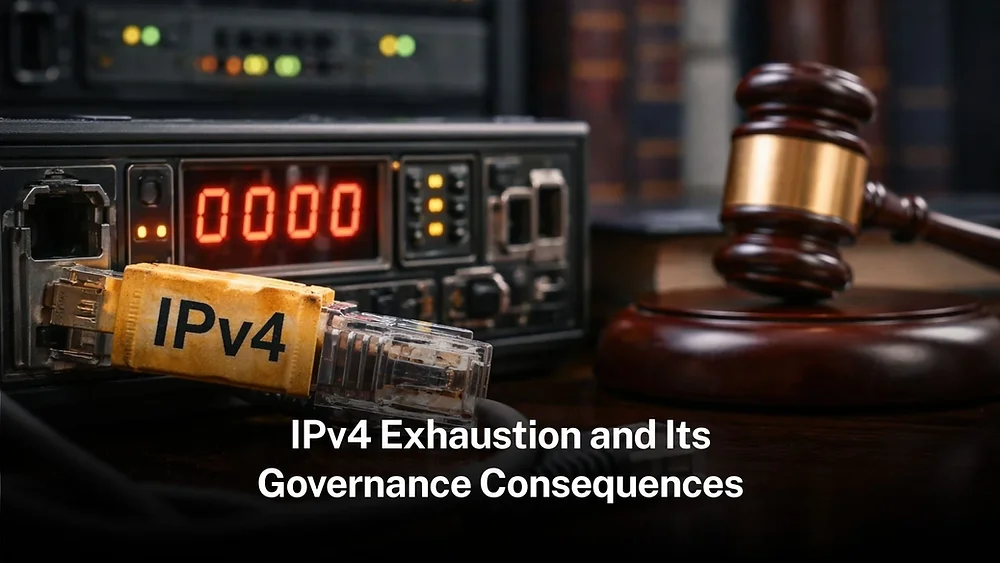
Every operator on the Internet rests on a structural assumption that, in reality, was never guaranteed: that the system allocating and maintaining IP numbers will always function, always renew, always coordinate, and always remain neutral. This belief held only when IPv4 was abundant and economically irrelevant. But as the Internet matured and IPv4 scarcity emerged, that assumption no longer holds.
IPv4 exhaustion has moved the Internet from a world of administrative allocation to one where IP addresses are priced, traded, and embedded in capital markets. What was once a technical resource has become a financial asset — and the governance mechanisms that support it have proven inadequate for this new economic reality.
IPv4 (Internet Protocol version 4) provides approximately 4.3 billion unique addresses. When the Internet was new, this appeared more than sufficient. But decades of dramatic growth in broadband access, mobile connectivity, cloud computing, and connected devices have consumed virtually all available IPv4 space.
By 2011, the Internet Assigned Numbers Authority had exhausted its free pool and allocated the remaining IPv4 blocks to the Regional Internet Registries (RIRs). Since then, IPv4 resources have circulated in secondary markets, with pricing strongly influencing infrastructure decisions.
As a result, IPv4 has shifted from administrative utility to capitalized resource — and the governance of that resource matters deeply.
A Structural Assumption That No Longer Exists
As the article “On why the registry layer is a structural risk and why LARUS is the only proven business continuity guarantor” notes:
“Every operator on the Internet assumes a foundation that does not actually exist: that the layer which governs who gets which IP numbers will always function, always renew, always coordinate, and always remain neutral.”
This quote highlights an important reality: the registry layer of the Internet does not rest on immutable guarantees. It rests on contracts, policies, and jurisdictional frameworks that are voluntary and limited in legal enforcement.
That assumption appeared to work when IPv4 was unpriced and plentiful. In a scarcity regime — where addresses have real value — the governance implications of that assumption become critical.
IPv4 Addresses Are Not Sovereign Property
A common misconception in today’s IPv4 market is that acquiring addresses through transfer or purchase gives the holder sovereign, perpetual property rights over those resources.
This is not the case.
When a party acquires IPv4 space, what they actually obtain is a renewable registration under an RIR’s policies and contractual framework. That registration is subject to:
Membership or service agreements
Policy compliance
Local legal jurisdiction
Ongoing consent by the registry
There is no constitutional guarantee of perpetual ownership. Instead, address resources are maintained through contractual agreements that include liability limitations, revocation rights, and ongoing compliance obligations.
Across all five RIR regions — AFRINIC, RIPE NCC, APNIC, ARIN, and LACNIC — the pattern is consistent: registries explicitly reserve authority to revoke, suspend, or reassign resources, and liability is typically capped at modest levels tied to service fees.
This means that an IPv4 holder’s operational downside risk is not fully protected by contractual safeguards, and the registry’s exposure to operational loss is limited.
There Is No Global Guarantor of Registry Continuity
Unlike some aspects of telecommunications infrastructure — such as domain name root services or routing protocols — there is no global sovereign authority that guarantees the ongoing function, neutrality, or renewal of Internet number resource registries.
If an RIR faces:
Political pressure
Litigation
Sanctions
Leadership instability
Internal governance disputes
there is no supranational enforcement mechanism that ensures perpetual registry service or neutrality.
This structure is fundamentally contractual and regional, not global and sovereign. Under exhaustion conditions — where resources are valuable — this governance arrangement introduces systemic risk that operators must acknowledge.
Scarcity Turns Governance into Risk
In the early Internet, when IP addresses were administratively allocated and economically irrelevant, the lack of formal guarantees beneath the registry layer was mostly academic. Registry policies functioned well enough in practice because the system was not economically stressed.
But in a scarcity-driven regime, where IPv4 addresses have real market value and operational significance, registry-layer risk becomes material.
Key areas of governance risk include:
Renewal Risk
Address assignments are subject to ongoing compliance and renewal conditions.
Revocation Risk
Registries retain authority to withdraw or suspend resources under policy triggers.
Jurisdictional Risk
Each RIR operates under its own legal environment with no harmonized global enforcement.
Contractual Interpretation Risk
Legal language governing resource assignments may be interpreted differently over time, with tangible consequences.
Counterparty Exposure
Direct holders of IPv4 registrations are directly exposed to governance events and contractual volatility.
For organizations that rely on stable connectivity and resource continuity, these governance risks are operational risks.
IPv6 Does Not Eliminate Governance Fragility
IPv6, the successor protocol with a vastly larger address space, was designed to address numerical scarcity. But IPv6 adoption remains uneven, and many networks continue to depend on IPv4 for core services.
Even in dual-stack environments that support both IPv4 and IPv6, IPv4 resources remain critical, and the governance framework around them continues to influence infrastructure decisions.
It’s important to recognize that IPv6 addresses the number space, not the governance structure of number allocation. The contractual and institutional arrangements that govern IPv4 also govern IPv6 allocations, and similar risks persist.
Strategic Implications for Internet Operators
For network operators, telecom carriers, cloud providers, hosting companies, and infrastructure investors, IPv4 exhaustion raises questions that extend beyond technical optimization:
What protections exist if registry policies change?
What happens if compliance disputes arise?
How does jurisdictional fragmentation affect global operations?
Who bears operational exposure in the event of registry discontinuity?
These questions highlight why operators can no longer treat registry continuity as a given. Scarcity has made governance a strategic concern.
Conclusion: Scarcity Has Changed Everything
IPv4 exhaustion was not just a technical milestone. It was a watershed moment that exposed the governance fragility of the Internet’s registry layer.
The assumptions that once held — that registry systems would always function, renew, and remain neutral — have been revealed as conditional and contractual.
In an environment where IPv4 resources are capitalized and traded, the governance structures beneath them matter. Operators must understand that:
IPv4 resources are not sovereign property
Registry continuity is a contractual arrangement, not a guarantee
Governance exposure is a material component of operational risk
The future of Internet infrastructure will be shaped not just by technology, but by how governance adapts to scarcity and economic value. Operators who recognize this reality will be better positioned to manage continuity risk — while those who assume the old model still applies may find themselves exposed.
FAQs
1. What is IPv4 exhaustion?
IPv4 exhaustion refers to the depletion of available IPv4 addresses. IPv4 provides roughly 4.3 billion unique addresses, and as global Internet usage grew, the free pool of unallocated addresses was exhausted. This scarcity has transformed IPv4 from an administrative resource into a valued, tradable asset.
2. How does IPv4 exhaustion impact Internet governance?
IPv4 scarcity exposes the limitations of the registry layer. Unlike technical routing systems, the registry layer relies on regional contracts, policies, and voluntary compliance. These agreements include liability caps and revocation authority, meaning that continuity is not guaranteed, and operators bear operational risk.
3. Do IPv4 addresses confer ownership?
No. Acquiring IPv4 addresses does not provide sovereign property rights. Holders obtain renewable registrations under RIR policies, subject to compliance, local jurisdiction, and revocable agreements. Liability is limited, and registries can suspend or reassign resources under certain conditions.
4. Does IPv6 solve these governance risks?
IPv6 addresses numerical scarcity but does not eliminate registry-layer governance risk. Even in dual-stack networks, IPv4 remains critical, and the same contractual frameworks apply. Governance and operational exposure must still be considered in planning and network continuity.
5. Why should operators consider registry-layer risk?
Operators that ignore registry-layer risk may face renewal issues, revocation, or legal exposure when policies or jurisdictional circumstances change. Understanding that IPv4 scarcity creates capitalized assets dependent on contractual continuity allows operators to plan strategically and mitigate potential disruptions.