
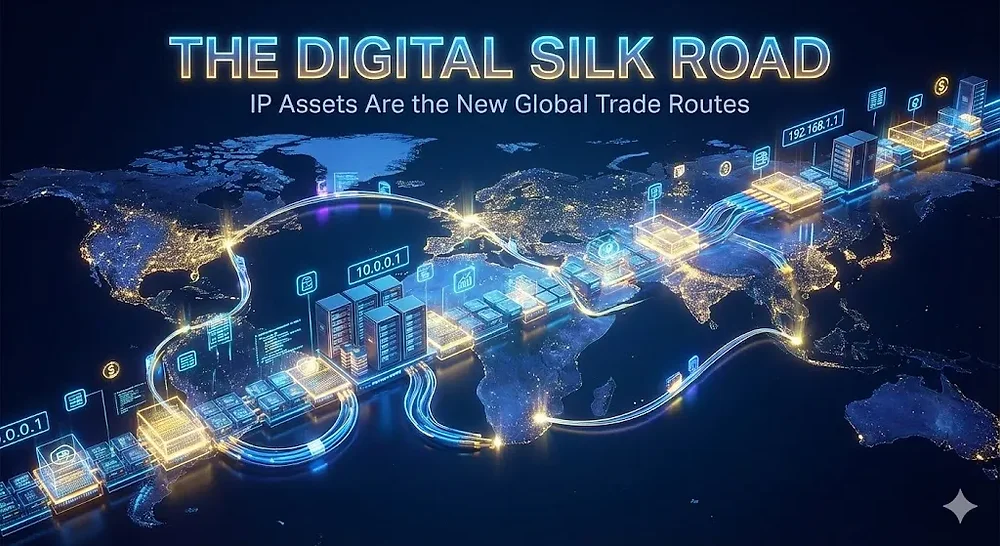
For centuries, the wealth of nations was determined by their control over physical trade routes. From the ancient Silk Road connecting East and West to the strategic importance of the Straits of Malacca, prosperity belonged to those who managed the "gateways" of commerce.
As we navigate through 2026, the map of global power has been redrawn. The most valuable trade routes are no longer made of stone or water; they are built on the logical infrastructure of the internet. In this new era, IP addresses are the modern equivalent of strategic port cities. If you do not own your IP assets, you are merely a "Digital Tenant" on someone else’s road.
IP Addresses as Modern Port Cities: The 300x Multiplier

In the physical world, a deep-water port allows a nation to engage in global trade. In the digital world, an IPv4 block serves the same purpose. It is the entry point for every packet of data, every financial transaction, and every bit of communication.
However, we are currently facing an era of extreme IPv4 Scarcity. Because there is a finite supply of these addresses, they have transitioned from a technical utility into Digital Capital. Organizations that recognize this shift are seeing a 300x Multiplier in the intrinsic value of their infrastructure. To understand the financial depth of these assets, it is essential to realize that IP is Capital, not just a line item on an IT budget.
The Threat of "Digital Blockades" and the Splinternet

The greatest threat to a trade route is a blockade. In the 21st century, these blockades are administrative. We are witnessing the rise of the Splinternet, a fragmented digital landscape where "Digital Walls" are being erected by national interests and overreaching registries.
This is the RIR Power Gap. Regional Internet Registries (RIRs) were designed to be "librarians" neutral stewards of records. Yet, many are beginning to act like "landlords," implementing policy updates that can reclaim "underutilized" space or devalue your assets overnight. Without Digital Sovereignty, your business is vulnerable to "Policy Eviction," effectively cutting you off from the Digital Silk Road.
Tech Diplomacy: Negotiating the New Borders

You cannot defend a digital trade route with a traditional navy. You defend it with Tech Diplomacy.
Tech Diplomacy is the specialized skill set required to navigate the intersection of technical architecture, global economics, and international policy. Currently, a massive Governance Gap exists: while Western powers have dominated the rooms where the "rules of the internet" are written, emerging markets have often been left "on the menu" rather than "at the table."
To protect your digital capital, you must bridge this gap through education and active representation in global forums like ICANN and the IGF.
Empowering the Future through the Larus Foundation

The Larus Foundation was established to ensure that the Digital Silk Road remains a "One World, One Internet" ecosystem. We believe that Universal Internet Education is the only way to protect the rights of resource holders in the Global South and beyond.
Through our Fellowship Programme, we train the next generation of Tech Diplomats. However, securing the future of the internet requires a collective effort from industry leaders, ISPs, and policy makers.
To expand our reach and protect more digital assets globally, we invite visionary organizations to join our Larus Foundation Partnership Program. By becoming a partner, you aren't just supporting education; you are investing in the stability and sovereignty of the global digital economy.
Conclusion:
The window to secure your place on the Digital Silk Road is closing. As IPv4 resources become even scarcer, the pressure from administrative bodies will only increase. You have a choice: remain a "Digital Tenant" at the mercy of shifting policies, or become an owner of your digital future.
Stop paying "rent" on your infrastructure. Start treating your IP assets as the strategic capital they are. Join us in building a secure, sovereign, and unified internet.
FAQs
1. Why are IP addresses compared to "trade routes" or "deep-water ports"?
In the physical world, commerce cannot flow without ports and roads. In the digital economy, IP addresses are the essential "gateways" that allow data, financial transactions, and communications to move globally. Without sovereign control over your IP blocks, your organization or nation is essentially a "landlocked" entity, dependent on others for digital access.
2. What is the "300x Multiplier" mentioned in the article?
The multiplier refers to the massive gap between the "administrative value" (the low maintenance fees paid to registries) and the actual market capital value of IPv4 addresses. Because IPv4 is a finite, scarce resource, its value as an asset has skyrocketed. Reclaiming your status as a "Digital Owner" allows you to realize this 300% increase in the intrinsic value of your infrastructure.
3. How has the role of Regional Internet Registries (RIRs) changed?
Historically, RIRs were designed to be "Librarians"—neutral record-keepers and stewards. However, as the value of IPv4 has grown, some are acting like "Landlords," implementing policies that can devalue your assets or reclaim your IP space under the guise of "administrative updates." This shift is what we call the RIR Power Gap.